
E15 Doesn't Cause Smog. It Reduces It.
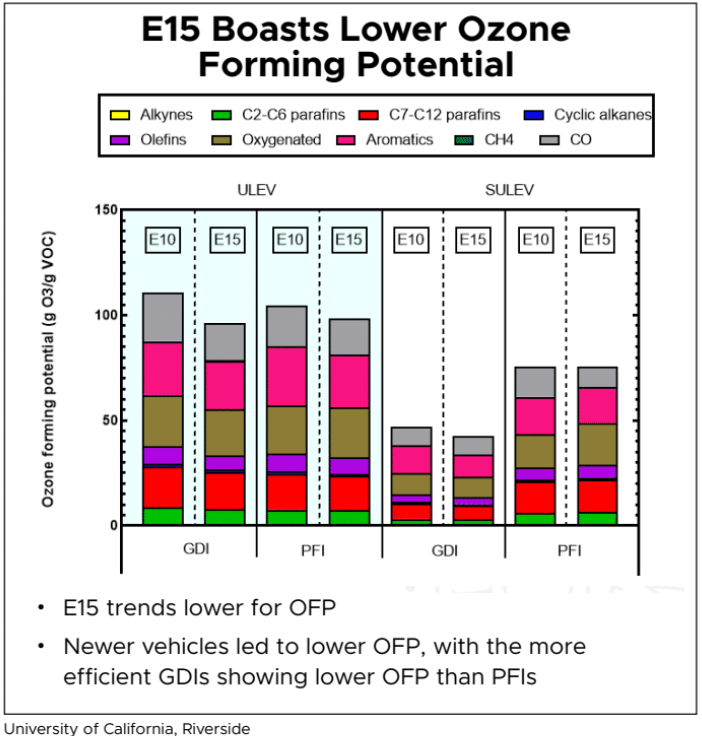
Does E15 contribute to an increase in smog?
No. E15 actually reduces the emission of smog-forming pollutants more than E10. This question was settled a decade ago when the Department of Energy (DOE)/National Renewable Energy Laboratory tested cars on E15 and E20 blends, and found that these fuels either produced no change or lowered smog-forming emissions.
Increased ethanol content means less pollution and healthier communities. A study by the University of California, Riverside commissioned by the California Air Resources Board (CARB) found that E15 had lower ozone-forming potential (OFP) than E10 due to reduced emissions of several volatile organic compound (VOC) ozone precursors, particulate matter (PM), and carbon monoxide (CO), all of which contribute to smog formation. The study also showed a significant reduction of total and non-methane hydrocarbons, which include toxic chemicals such as benzene, toluene, and xylene. Reducing these emissions can result in cleaner air and a healthier environment.
At the same time, ethanol reduces GHG emissions by 46% compared to regular gasoline, making biofuels a key to achieving cleaner air. As a result, nationwide adoption of E15 could cut GHG emissions by 17.62 million tons per year, which is the equivalent of removing approximately 3.85 million vehicles from the road.
That’s why a permanent fix is so important. We can’t let outdated regulations stand in the way.